
China High-Speed Rail for Foreign Travelers: The Ultimate 2026 Guide
China's high-speed rail (HSR) network is the largest in the world — over 45,000 kilometers of track connecting nearly every major city. For foreign travelers in 2026, it's the single best way to experience the country: fast, affordable, comfortable, and scenic.
Why Choose High-Speed Rail in China?
China's bullet trains consistently outperform alternatives:
- Speed: Most routes run at 250–350 km/h. Beijing to Shanghai takes just 4.5 hours.
- Punctuality: Average delay under 1 minute. Trains run on a strict schedule.
- Comfort: Spacious seats, power outlets, meal service on longer routes, and onboard Wi-Fi.
- Price: Typically 50–70% cheaper than flights when you factor in airport transfers.
- Scenery: Routes through Guilin, Sichuan, and along the Yangtze offer jaw-dropping views.
Understanding the Train Types
G-Series — The Fastest
Top speed: 350 km/h. Premium bullet trains connecting major cities like Beijing–Shanghai (4.5h), Beijing–Guangzhou (8h), and Shanghai–Chengdu (12h).
D-Series — High-Speed
Top speed: 250 km/h. Slightly slower but more frequent. Great for regional routes and smaller cities with second class, first class, and sleeper options.
K/Z/T-Series — Conventional Trains
Slower overnight trains (100–160 km/h). The hard sleeper is a beloved budget option — bunks in open compartments with blankets. A genuine Chinese travel experience.
How to Buy Tickets as a Foreigner
Option 1: Official 12306 App
The official app now accepts foreign passports directly. Download it, register with your passport number, and pay with international credit card or Alipay. Best prices with no markup.
Option 2: Trip.com (Ctrip)
English-language interface, accepts all major cards, and charges a small service fee (~5-10 yuan). Very user-friendly for first-timers.
Option 3: Station Ticket Windows
Bring your passport. Staff at major stations can sell you tickets on the spot. Have your destination written in Chinese characters ready.
Pro tip: Book at least 3-5 days in advance for popular routes. During Chinese holidays, tickets sell out within minutes.
Navigating Train Stations
Chinese train stations are large, modern, and efficient. Here is the process:
- Arrive 30-45 minutes early. Stations have airport-style security.
- Find your waiting room. Check the departure board for your train number and platform.
- Scan your passport or QR code at the gate. No paper ticket needed on most routes.
- Board the train. Find your carriage number and seat number on your ticket.
Seat Classes Explained
Second Class — ~553 yuan Beijing-Shanghai. 3+2 seating, adequate legroom, perfect for short trips.
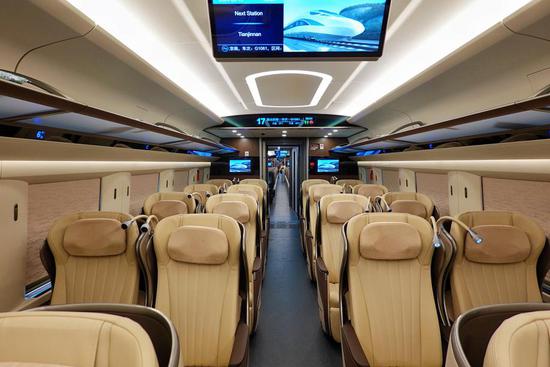
First Class — ~933 yuan Beijing-Shanghai. 2+2 seating, wider seats, power outlets, quieter.
Business Class — ~1,748 yuan Beijing-Shanghai. Lie-flat pods, meals included, premium experience.
For most travelers, first class hits the sweet spot of comfort and value.
Must-Try Routes for Foreign Visitors
Beijing to Shanghai (4.5 hours)
The crown jewel. Two of China's most iconic cities connected by a 1,300 km super-highway. Take the morning G-train and arrive before lunch.
Chengdu to Chongqing (1.5 hours)
Food capitals of China. Hot pot in Chongqing, pandas in Chengdu. Do both in one trip.
Guilin to Yangshuo (45 minutes)
Arguably the most scenic rail journey in China. Karst peaks, rice paddies, and the Li River.
Shanghai to Hangzhou (45 minutes)
West Lake, silk, tea plantations, and the stunning Lingyin Temple. Perfect day trip or weekend getaway.
Xi'an to Chengdu (3 hours)
Terracotta warriors to giant pandas. Two of China's most distinctive cities in one high-speed corridor.
Practical Tips
- Luggage: No strict weight limits, but oversized items must go in designated areas. Backpacks are easiest.
- Food: Buy snacks before boarding. Most trains have a dining car with hot meals.
- Wi-Fi: Free on most G-series trains. Signal can be spotty in mountainous areas.
- Power: Second class has outlets on the wall between seats. First class has individual outlets.
- Water: Hot water dispensers at the end of every carriage — perfect for instant noodles or tea.
Combining Rail with Other Transport
High-speed rail works brilliantly as part of a larger itinerary. Fly into Beijing, take the train to Xi'an, continue to Chengdu, then fly out of Chongqing. Or start in Shanghai, train to Hangzhou, then Guilin.
Final Thoughts
China's high-speed rail isn't just transport — it's an experience. The efficiency, the landscapes, the sheer scale of the network make it one of the world's great travel systems. In 2026, with improved foreigner-friendly booking and English signage, there's never been a better time to explore China by rail.