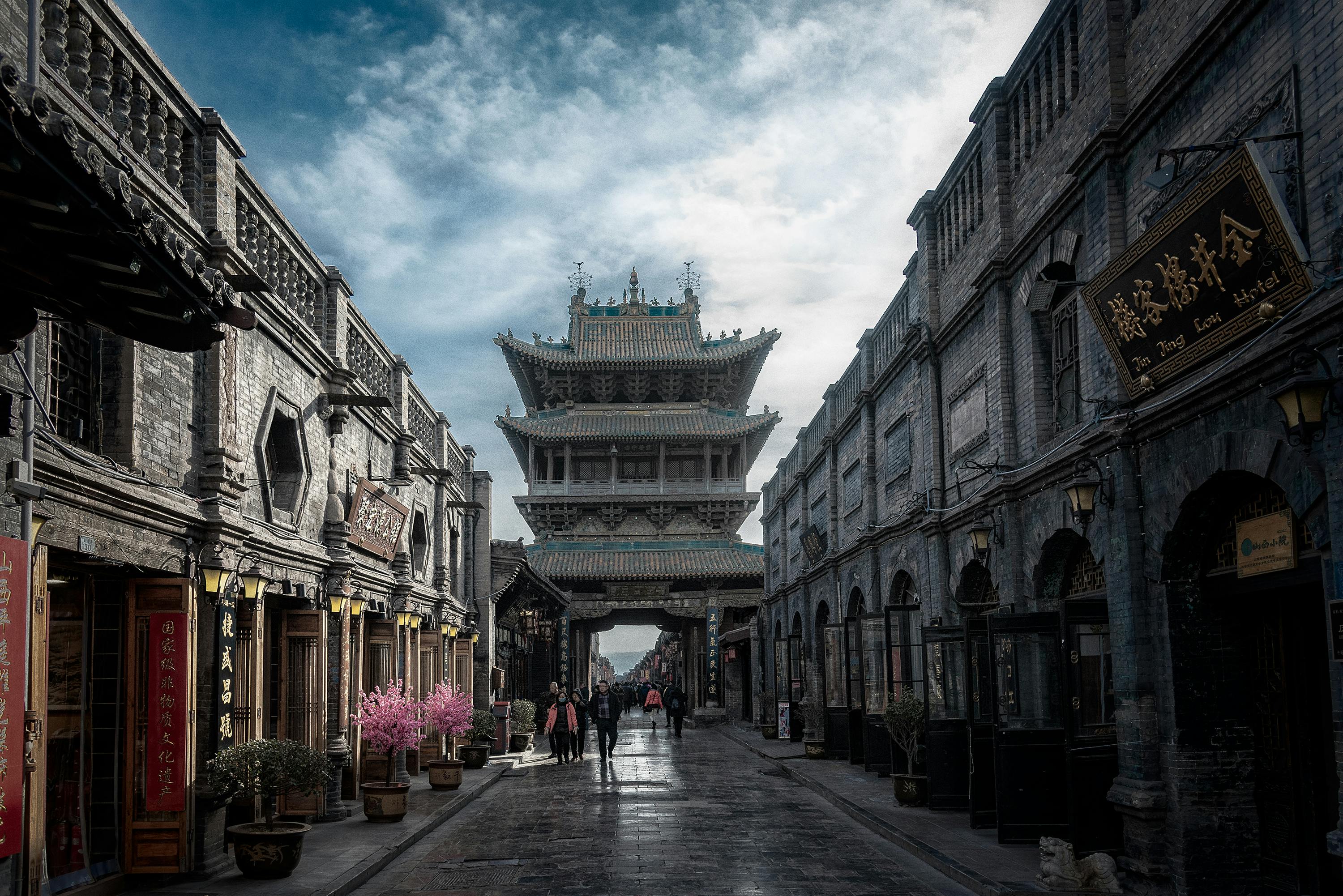
Pingyao is the best-preserved ancient walled city in China - a complete Ming and Qing dynasty town that survived the 20th century almost untouched. Encircled by a six-kilometer brick wall with watchtowers, moat and original gates, it was named a UNESCO World Heritage Site in 1997. For foreign travelers who want to see what a wealthy Chinese trading city looked like 200 years ago, Pingyao is the most atmospheric, walkable and affordable choice in northern China.
Why Visit Pingyao
- An intact walled city: unlike most Chinese old towns, Pingyao keeps its full city wall, gates and street grid - about 4,000 original courtyard houses survive inside.
- Birthplace of Chinese banking: Shanxi merchants invented the piaohao (draft bank) system here in the 19th century, making Pingyao the Wall Street of Qing-dynasty China.
- Authentic Ming-Qing streets: Ming-Qing Street and the lanes around it are lined with original shop fronts, not rebuilt facades.
- Easy to combine: it sits on the high-speed rail line between Beijing, Taiyuan and Xi'an, so it fits neatly into a Beijing-Xi'an itinerary.
Best Time to Visit
April to June and September to October are the best months - mild temperatures, blue skies and few crowds outside national holidays. July and August are hot, while winter (December to February) is cold and quiet, with occasional snow making the grey-tiled rooftops beautiful. Avoid the first week of October (National Day Golden Week), when the narrow streets are packed.
Top Things to See
Walk the Ancient City Wall
The 6.4-kilometer wall was first built in the Ming dynasty (1370) and later repaired. Climb up at the South Gate or the East Gate tower and walk the full circuit - it takes about two hours and gives you rooftop views over the old town. Sunset from the western section, with the sun dropping behind the watchtowers, is the classic photo moment.
Ming-Qing Street (South Street)
The main north-south artery, Ming-Qing Street is a living museum of Qing-era commerce: lacquerware shops, paper-cutting studios, vinegar cellars and snack stalls. Drop into a Shanxi vinegar shop to taste laochencu (old vinegar) straight from the vat - locals drink it like tea. The street is at its best early in the morning before tour groups arrive.
Rishengchang Draft Bank
Founded in 1823, Rishengchang was China's first draft bank, moving silver across the empire using paper notes. The restored complex shows the counting rooms, vaults and the famous "hui tong tian xia" (remittance reaches the world) plaque. It is the single most important sight in Pingyao for understanding why this small town once controlled much of China's finance.
County Government Office (Yamen)
The largest intact county yamen in China, this walled compound within the walled city held courts, prisons and the magistrate's residence. The waxwork court scenes and the grim prison cells give a vivid sense of how county administration worked under the Qing dynasty.
Temples and Museums in the Old City
Don't miss the Confucian Temple with its striking original Ming hall, the City God Temple with its colorful roof figures, and the Qingxu Taoist Temple. The combined ticket covers all of these plus dozens of smaller courtyard museums, so you can simply wander in and out.
Just Outside the Walls
Two UNESCO-associated temples deserve a half-day. Shuanglin Temple, about 6 km south, holds more than 2,000 painted clay sculptures from the Song, Yuan and Ming dynasties - among the finest surviving Buddhist sculpture in China. Zhenguo Temple preserves a 10th-century wooden hall, one of the oldest in China. If you have extra time, the Qiao Family Compound, 30 km away, is the grand courtyard mansion made famous by the film Raise the Red Lantern.
Where to Stay
The classic Pingyao experience is a night inside the walls in a restored siheyuan (courtyard house), often a former merchant mansion with carved timber and brick screens. Rooms are inexpensive compared with Beijing or Shanghai. Book ahead on Ctrip or Booking.com in peak months, and confirm the guesthouse is actually inside the city wall - many listings are in the modern town outside. See our guide to booking hotels in China for tips.
What to Eat
- Pingyao beef: the town's signature, a slow-braised spiced beef sliced thin and served cold with vinegar.
- Wan tuo: steamed buckwheat slices in a garlic-vinegar dressing - cheap, filling and very local.
- Kaolaolao: rolled oat noodles steamed in a basket, served with tomato or meat sauce.
- Shanxi noodles: knife-cut noodles (daoxiaomian) and other wheat specialties are a staple - Shanxi is China's noodle heartland.
Getting There
Pingyao has its own high-speed station, Pingyao Gucheng, on the Datong-Xi'an line. From Beijing it is roughly 3.5-4 hours, from Taiyuan about 40 minutes, and from Xi'an about 2 hours by high-speed train. Regular trains also stop at the older Pingyao station in the new town, a short taxi or Didi ride from the wall. The nearest major airports are Taiyuan Wusu and Xi'an Xianyang; see our high-speed rail guide for how to buy tickets as a foreigner.
Practical Tips for 2026
- Tickets: buy the combined pass (about 125 yuan) which covers the city wall, Rishengchang, the county office and more than 20 sites; it is valid for three days.
- Getting around: the old city is car-free and easily walkable; rent a bicycle or take an electric cart for longer hops.
- Payments: WeChat Pay and Alipay are accepted everywhere inside; set them up before you arrive (WeChat Pay guide, Alipay guide).
- Connectivity: an eSIM works well here since you will rely on maps and translation apps (eSIM guide).
- Getting from the station: use Didi or the local taxi line; the old city gates close to vehicle traffic in the evening, so walk the last stretch (Didi guide).
- Language: almost no English is spoken; keep a translation app and the Chinese characters for Pingyao (平遥) handy.
Sample Two-Day Route
Day 1: arrive by high-speed train, check into a courtyard guesthouse, then walk the city wall at sunset and explore Ming-Qing Street in the evening when the lanterns are lit. Day 2: morning at Rishengchang and the county office, lunch of Pingyao beef and wan tuo, then Shuanglin Temple in the afternoon. If you are heading to Xi'an next, the train connection makes Pingyao an easy one-night stop between the two capitals of Chinese history.