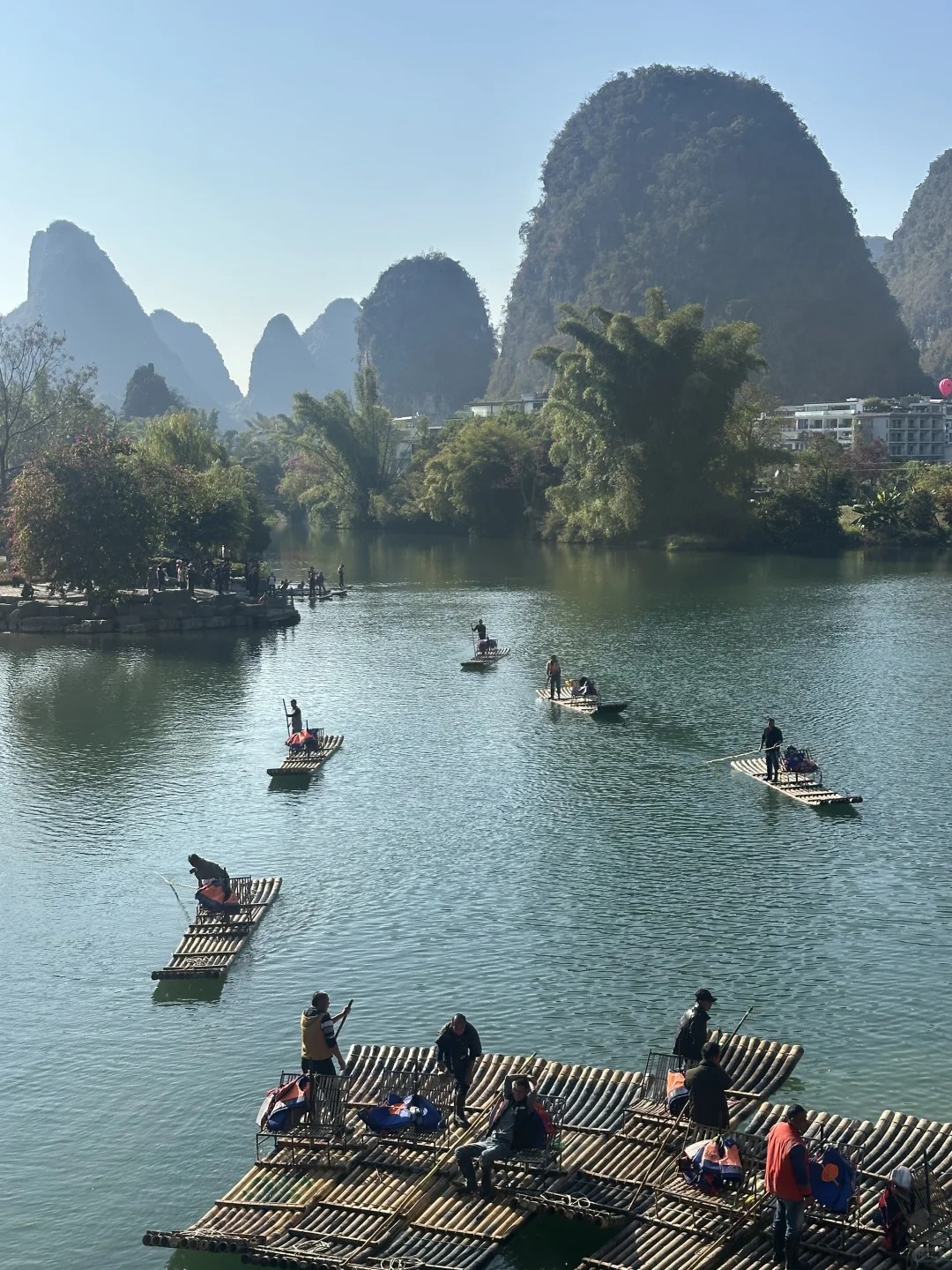
Yangshuo is where the postcard of China actually comes from. A small town in Guangxi surrounded by hundreds of limestone peaks that rise vertically out of rice paddies and rivers, it has been the backdrop for ink paintings, currency notes and more than a few films. What surprises most first-time visitors is not the scenery — they have seen the photos — but how quickly the landscape becomes something you move through rather than look at: on a bicycle, on a raft, or on foot between villages.
This guide is written for foreign travelers. It covers how to reach Yangshuo from Guilin, where to base yourself, the difference between the Li River and the Yulong River, climbing and outdoor days, a Longji Rice Terraces side trip, what to eat, what it costs, and a simple three-day plan.
Where Yangshuo is and how to get there
Yangshuo (阳朔) sits in Guangxi, about 65 km south of Guilin. Almost everyone arrives through Guilin first, and there are three workable ways in:
- High-speed rail to Yangshuo Station — the fastest option. Trains from Guilin take around 25-30 minutes; there are also direct services from Guangzhou (about 2.5 hours) and Shenzhen. Yangshuo Station is roughly 20-25 km from the town centre, so budget for a taxi or the shuttle bus at the other end.
- Guilin Liangjiang International Airport (KWL) — most international travelers fly in here. Direct airport buses run to Yangshuo several times a day (about 1.5 hours); a private transfer takes a little over an hour.
- Guilin city to Yangshuo by bus — frequent departures from Guilin's main bus stations, around 1.5 hours. Cheapest, slowest, and perfectly fine if you are not in a hurry.
Book rail tickets in advance through the official 12306 app or a booking platform that accepts foreign passports. If you are still sorting out payments for transport and food, set up Alipay or WeChat Pay before you arrive — cash works in Yangshuo but is increasingly a hassle.
Where to stay: three very different bases
- West Street (Xi Jie) and the town centre — the busiest area, packed with bars, cafés, hostels and souvenir shops. Convenient for food and nightlife, noisy at night. Good for a first visit of one or two nights.
- The Yulong River valley — guesthouses scattered among paddies and karst peaks, 15-30 minutes by bike or scooter from town. This is where the scenery lives. Quieter, more expensive, and the right choice if you want mornings of mist over the river.
- Xingping — a smaller old town further down the Li River, close to the classic 20-yuan-note viewpoint. Slower, less commercial, excellent for photography and for catching the river before the tour boats arrive.
Book ahead for weekends, Chinese public holidays and the first half of October, when domestic tourism peaks and prices roughly double.
The Li River: cruise or raft?
The Li River between Guilin and Yangshuo is the headline attraction, and there are two very different ways to see it.
The four-hour cruise from Guilin to Yangshuo is the classic: a large boat, a fixed route, and the section of river with the most dramatic peaks. It is efficient, comfortable and completely unspontaneous. Buy tickets the day before, arrive early, and expect the best views in the middle third of the journey.
The bamboo raft trips around Xingping are the better experience for most travelers. They cover the stretch between Xingping and the Nine Horse Fresco Hill, last roughly an hour, and put you close to the water with the peaks towering on both sides. Rafts are motorised, life jackets are provided, and operations are suspended after heavy rain when the river runs high — always confirm the day before.
Whichever you choose, go early. By mid-morning the main viewpoints are crowded and the light is flat.
Cycling the Yulong River
Cycling is the single best thing to do in Yangshuo, and the Yulong River loop is where to do it. The route runs from town through villages, bamboo groves and rice paddies, with the river on one side and karst peaks on the other. It is mostly flat, largely traffic-free and easy to follow.
- Rent a bicycle (roughly 30-50 yuan a day) or an electric scooter (80-150 yuan a day). Bring your passport for the deposit.
- Follow the signed riverside paths rather than the main road; the small bridges at Jiuxian, Chaolong and Gongnongqiao are the highlights.
- Timing — leave by 8am. Mornings are cool, quiet and often misty; afternoons get hot and busy.
- Swimming in the Yulong is popular in summer, but only do it where local families do, and never after rain when the current is strong.
Climbing, caves and other active days
Yangshuo is one of Asia's best-known sport climbing destinations, with hundreds of bolted routes on limestone from beginner-friendly slabs to steep overhangs. Several local schools rent gear and run half-day courses with English-speaking guides, and the crags around the Yulong River and Moon Hill are easy to reach by scooter.
Non-climbers are not left out: the karst is riddled with caves, including the large illuminated caverns near Moon Hill, and kayaking and stand-up paddleboarding are both available on the Yulong. The Xianggong Hill sunrise viewpoint and Moon Hill are the two classic short hikes; both take under an hour to climb.
Longji Rice Terraces and other day trips
The Longji Rice Terraces (Dragon's Backbone) near Longsheng, about 2.5-3 hours away, are the most rewarding day trip from Yangshuo. Terraces wrap the hillsides in ribbons, with the Zhuang and Yao villages of Ping'an and Dazhai as bases. It is a long day if done from Yangshuo — many travelers instead stay one night. The best light is at sunrise and sunset, and the terraces are green in summer, gold before the October harvest, and flooded mirrors in spring.
Closer to town, Xingping Old Town and the 20-yuan viewpoint make an easy half-day, and Fuli is worth a stop for its market and painted fans.
What to eat in Yangshuo
- Beer fish (pijiu yu) — the local signature: river fish braised with beer, tomatoes, chilli and ginger.
- Guilin rice noodles — the regional breakfast, cheap and excellent, served dry with pickles and peanuts.
- Stuffed Li River snails — minced pork and mint packed back into the shells.
- Bamboo rice and oil tea — the latter is a bitter, savoury infusion popular with the Yao communities.
West Street is convenient but tourist-priced; the streets behind the market and the village restaurants on the cycling routes are better value. Tell staff "bu yao tai la" (not too spicy) if you need to.
Best time to visit and what it costs
Spring (April-May) and autumn (September-November) are the best months: green or golden fields, comfortable temperatures and clearer light. Summer is hot, humid and rainy, and the river can run brown after storms. Winter is quiet, misty and cheap, with cool rather than cold days.
A realistic mid-range budget is 400-700 yuan per person per day for a good guesthouse, meals, bicycle or scooter rental and one paid activity — less if you stay in a hostel, more in the riverside boutique properties. Entrance fees and raft tickets add up quickly, so keep some cash for smaller operations.
A simple three-day plan
- Day 1 — Arrive from Guilin, settle in and walk West Street and the riverbank at sunset. Book your raft or cruise for the following morning.
- Day 2 — Early bamboo raft at Xingping, then the 20-yuan viewpoint and Xianggong Hill for sunset. Evening back in town for beer fish.
- Day 3 — Full day cycling the Yulong River with lunch in a village, or climbing with a local school if the weather holds. Add Longji as a fourth day, or swap it in for the raft day if terraces matter more to you than the river.
Practical tips
- Carry your passport — it is required for hotels, raft tickets and scooter rental.
- Download offline maps; village lanes are poorly signposted and phone signal drops in the hills.
- Bring mosquito repellent from May to September and a rain jacket year-round.
- Touts at the bus station sell "tours" aggressively; independent operators and your guesthouse are usually better and no more expensive.
- Weekdays are dramatically quieter than weekends, and the difference in crowd levels is worth planning around.